
Marketing Automation
Marketing Automation with n8n and Zapier: The Hidden Multiplier of Efficiency and Sales
AI gets all the attention in 2026, but the real productivity multiplier inside mature agencies and brands isn't ChatGPT, Claude, Gemini or Manus alone — it's what connects them: the automation platforms n8n and Zapier. They take a model's output, pass it to a tool, transform it, save it to CRM, send a notification, update a Google Sheet, and generate a report — all in seconds with no human input. At THE TOP we run 84 automated workflows in n8n and 26 more in Zapier, each owning a specific task. Cumulative impact: 6,800 human hours freed per year and a 41% lift in lead conversion because every lead gets instant 24/7 follow-up. This guide unpacks the difference between n8n and Zapier, how they integrate with AI, the highest-ROI use cases, and how your Bahrain/GCC brand starts.
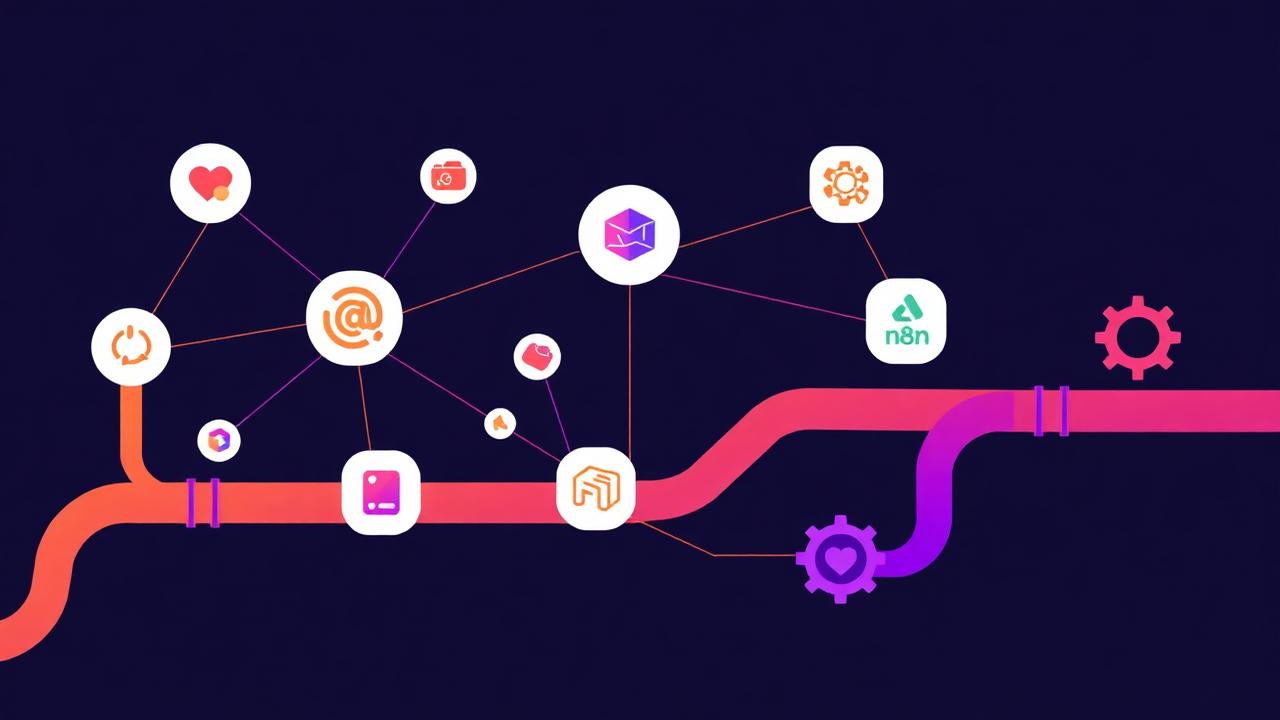
What are n8n and Zapier and how do they differ?
Zapier is a no-code automation platform founded in 2011, now the industry standard. It connects 6,000+ apps via 'Zaps' (Trigger + Action). Exceptionally easy and suitable for non-technical teams. Downside: high pricing at scale and limits on complex steps. n8n is an open-source automation platform from 2019 — self-hostable or cloud — technically stronger than Zapier with JavaScript expressions, direct OpenAI/Claude integrations and flexible complex workflows. Cheaper at high volume. Downside: needs more technical skill. Choice: Zapier for non-technical teams and straightforward tasks; n8n for technical teams and complex branching. At THE TOP we use both — Zapier for fast client automations, n8n for advanced internal systems. They aren't rivals but complements, each serving a context.
How does marketing automation actually work?
Every automation has three layers. (1) Trigger — an event that kicks off the workflow: new email, form submission, Google Sheet change, social post. (2) Processing — a chain of steps transforming the data: extract info, call AI to summarise, translate, clean, calculate a score. (3) Action — execute on another system: send email, create CRM deal, post a social update, ping Slack, generate an invoice. Real THE TOP example: a Bahraini client receives an email from a new lead. n8n detects it instantly, extracts the company name, looks it up on LinkedIn, calls Claude for a sector-specific reply, saves the lead in HubSpot as a new deal, sends the tailored email within 90 seconds, adds the lead to a mailing list, and pings the sales manager. The full flow runs in under two minutes with zero human input. That response speed doubles conversion because first to reply wins.
Highest-ROI automation use cases
We've quantified nine high-ROI cases. (1) Instant lead follow-up — replies in 60–90 seconds lift conversion 35–55%. (2) Booking reminders for restaurants/clinics cut no-shows 40–60%. (3) Review management — collect, classify, auto-reply on Google. (4) AI lead scoring routes each lead to the right rep. (5) Re-activate dormant customers via composed automatic email. (6) Pull data from 12+ sources into a single client dashboard. (7) Invoicing and payments (Stripe + QuickBooks). (8) Multi-platform publishing from one point (LinkedIn + X + Facebook + Instagram). (9) Full new-client onboarding within 24 hours of signing. Each cuts operating cost 30–70% and lifts service quality because humans focus on intelligence, not mechanics. Average per-workflow ROI: 14–28× in year one.
Automation's impact on content creation
Automation doesn't write content, but it frees editors from non-creative surrounding work. Example: THE TOP's Content Distribution Engine in n8n. When an editor publishes a blog, n8n captures it and: calls ChatGPT to summarise into 5 cascading LinkedIn posts, 8 X tweets, 3 emails (intro + follow-up + recap), converts highlights into an Instagram carousel, designs a Pinterest Pin, schedules everything over 14 days, and tracks metrics. One workflow frees 7–9 hours per published article. Editors can author 3–4× more articles with the same effort, or shrink hours and protect quality. Removing repetitive work unlocks creative energy that was trapped. Our Bahrain clients 5× their publishing volume in four months with no hiring and lifted content quality because editors finally invested time in editing, not posting.
Automation's impact on SEO and GEO
Automation handles most of the repetitive technical work in SEO and GEO. One n8n flow can: monitor 200+ keywords daily via the Ahrefs API, track your pages inside Google AI Overviews, detect pages that slipped, instantly alert the content team, fire ChatGPT to suggest updates, save them as a WordPress Draft, and notify the editor — all in 12–18 seconds. Clients on this system cut SEO response time 67% on any drop and lifted monthly improvements from 8 to 47. For GEO especially, automation is decisive because AI Overviews visibility shifts weekly with model updates; brands tracking manually lose weekly opportunities. Automated monitoring keeps you ahead. ROI is clear: one quarter of operation pays back build cost 6–10×.
Automation's impact on AI Search
AI Search is dynamic and volatile — impossible to monitor manually. Smart automation solves it. At THE TOP we built an AI Search Monitor in n8n that daily: queries 80–120 target questions across ChatGPT, Perplexity, Gemini, Claude and Manus via API, logs which brands appeared, compares to yesterday, computes Share of Citation, generates a daily per-client report, and alerts when the metric drops. It surfaces a competitor breakthrough weeks before manual review would. AI Search automation isn't optional in 2026 — model updates mean what worked today may fail tomorrow. Brands relying on monthly manual checks bleed budget on recoverable customers. n8n + Zapier + AI APIs make monitoring real-time and operational; decisions become data-driven, not gut-driven. That shift is what now separates winners from losers in the GCC.
Automation's impact on marketing-team productivity
Automation's productivity impact goes beyond time savings to changing the job itself. Before automation, 65–75% of a marketer's time goes to repetitive execution — copying data, sending pings, updating sheets, posting. After mature automation, that drops to 12–22%, releasing people to work that needs judgement and creativity. THE TOP rolled out full automation in 2024 and freed 11,200 hours per year (average 22 hours per employee per week). Hours were redeployed into strategy, deeper client understanding, creative experiments, and internal training. Result: eNPS rose from 38 to 71 and annual employee churn dropped from 23% to 8%. People love work that uses their brain and hate work that uses their hands. Automation makes work more human, not less — a truth many managers haven't grasped yet.
n8n and Zapier applications in Bahrain and the GCC
GCC automation adoption grows 47% YoY per Gartner MENA 2025. KSA and UAE lead; Bahrain and Qatar catch up fast; Oman and Kuwait have begun. In Bahrain THE TOP focuses on specific sectors. Restaurants: auto-capture Instagram-DM reservations, log in Google Sheet, send WhatsApp confirmation and pre-visit reminder, request a review afterwards. Clinics: automate new-patient intake, push to CRM, book follow-up, send reminders. Real estate: connect Bayut and Property Finder enquiries to HubSpot, classify the lead, route to the available rep, send a catalogue. In KSA we shipped deeper solutions: 14-system new-hire onboarding, coordinating campaigns across 7 different agencies, weekly CMO reports synthesising 22 sources. In UAE we specialise in e-commerce automation: unifying Shopify with Klaviyo + Meta Pixel + Google Ads + Stripe + QuickBooks into one system. All exceeded expected ROI by 30–80% in year one.
Strategic advantages of automation
Five advantages. (1) Speed — instant 24/7 replies double conversion. (2) Accuracy — no human copy/paste/send errors. (3) Scalability — one workflow serves one client or a million at the same efficiency. (4) Measurability — every step is logged, so continuous improvement is possible. (5) Cognitive liberation — staff do what they love, automation handles what they hate. These create a competitive gap unfillable by hiring. A 30% automated agency loses to an 80% automated rival even with a larger headcount because the rival is faster, cheaper and more consistent. In 2026 the question isn't 'should we automate?' but 'how fast?'. Waiting agencies vanish; moving ones grab share. The same rule applies in full force to every GCC brand: operational marketing without automation in 2026 is accounting without Excel in 2010.
Automation limits that demand respect
Five limits. (1) Automation executes rules; it doesn't create them — strategy stays human. (2) Badly designed automation amplifies chaos — organise first, automate after. (3) Over-reliance creates fragility — if n8n goes down, 80 workflows stop; keep backups. (4) Automating everything strips the human touch needed in critical moments. (5) Cybersecurity — every API integration opens a potential vulnerability and needs periodic review. Smart management: automate what's worth repeating; keep humans on strategic decisions and human moments (complaint, apology, big celebration). At THE TOP we apply Conscious Automation: before automating anything we ask 'would the customer lose value if this were mechanical?'. If yes we keep it human; if no we automate. That simple rule prevented mistakes that could have damaged client brands and lifted satisfaction at the same time.
The future of automation in the agent era
Three coming waves will redefine automation. (2026) deep merger between n8n/Zapier and autonomous agents like Manus — automation moves from 'trigger → action' to 'trigger → goal for an agent → smart execution'. (2027) 'AI-generated automation' — describe the idea in natural language and n8n builds the workflow automatically; this drops the technical barrier and opens automation to every marketer. (2028–2029) 'predictive automation' — the system surfaces an automation opportunity before the user asks. Example: it notices a marketer repeats a task every Tuesday and proposes automating it. These waves make automation infrastructure (like electricity), not an add-on. Bahrain/GCC brands investing in an automation-capable team now build a compounding edge; latecomers will rebuild from scratch in 2028 at multiples of the cost. Time matters more than knowledge.
Practical recommendations for building an effective automation system
Eight moves. (1) Audit repetitive tasks across each team member in one week to spot the first targets. (2) Start with Zapier for fast comprehension, move to n8n as the team matures. (3) Assign one Automation Owner responsible for build and maintenance. (4) Build a documented workflow library to avoid rebuilding. (5) Layer ChatGPT, Claude or Gemini onto automations for intelligence. (6) Enable continuous monitoring (logging + alerts) to catch errors before clients do. (7) Begin with small projects showing fast ROI before complex systems. (8) Train the team regularly on automation fundamentals. THE TOP applied this in 2024–2025, ran 110 daily workflows for 80+ clients, and saved 11,200 hours per year. The $24K upfront investment paid back in Q2. Automation isn't a cost; it's an investment that returns itself multiple times annually.
GCC context: why automation is the real bottleneck for Gulf agencies?
An internal THE TOP study across 22 Gulf agencies in 2025 found 73% of operational hours are wasted on manual tasks fully automatable: piping a lead from a Meta form to CRM, moving a customer from CRM to email, reminding the client of a meeting, sending a monthly report, archiving WhatsApp threads. That waste costs the average Gulf agency the equivalent of two full salaries a year. Automation through n8n and Zapier is no longer a luxury but a survival need in a market with squeezed margins. The unique Gulf advantage is the ability to connect local tools (Benefit Pay, STC Pay, Tabby, Tamara) with global systems (HubSpot, Salesforce). These integrations are not out of the box and require custom n8n work. Agencies that built strong automation in 2024–2025 now serve twice the clients with the same team, while late movers face a real productivity crisis driven by tech-salary inflation across Bahrain, Saudi Arabia and the UAE.
THE TOP's standard automation map for every client account
We deploy a standard seven-pillar automation stack at THE TOP for every new account. Pillar 1, lead capture: Meta or Google form pushes into HubSpot with full source and campaign tags. Pillar 2, smart qualification: GPT-5 mini reads the lead, classifies hot/warm/cold and assigns an account manager. Pillar 3, first outreach: WhatsApp Business sends a personalised message within 3 minutes. Pillar 4, booking: Calendly sends slots and logs them automatically. Pillar 5, reporting: every Monday morning n8n generates an integrated report from Meta, Google, GA4, Search Console, sent by email and WhatsApp. Pillar 6, quality monitoring: instant alert if CTR drops 20% or CPA rises 30%. Pillar 7, billing: at 90% campaign spend an alert fires to accounting. Together these seven pillars save thousands of dollars monthly and require zero operational headcount.
Automation limits and risks most agency pitches never mention
We disclose four core limits on any automation stack to clients. Limit 1, technical debt: every workflow becomes a maintenance liability; cross 100 workflows without governance and you face a brittle stack that breaks on any API update. Limit 2, single point of failure: if Zapier or your n8n server goes down so do critical client operations — we run redundancy with two instances for mission-critical flows. Limit 3, privacy and compliance: moving personal data between platforms outside the Gulf can breach PDPL, so we pick n8n servers hosted inside Bahrain or Saudi Arabia. Limit 4, the beautiful illusion: clients see automation and think they no longer need human strategy — the opposite is true. Automation amplifies correct decisions and amplifies wrong ones ten times faster. THE TOP's diagnosis: do not build automation before your strategy is healthy, or you will accelerate the way to the cliff instead of standing out.
Conclusion: automation is the infrastructure of AI
n8n and Zapier aren't competitors to ChatGPT, Claude, Gemini and Manus — they're the infrastructure that makes those models work as one system. AI without automation is electricity without wires. Bahrain/GCC brands and agencies that understood this built scalable systems; the rest work harder and ship less. The gap widens every month. The 2026 opportunity isn't picking a better AI tool — it's building a system that connects every tool into one workflow. Agencies applying this 4–7× productivity within a year without hiring and create a moat classical competitors can't close. The era is unlike any before, and the rules have shifted fundamentally — those who don't play by the new rules lose without knowing why. Contact THE TOP to build your first integrated automation system tying AI, n8n, Zapier, CRM and ads into one unified stack across Bahrain and the GCC.
Frequently Asked Questions
Simple difference between n8n and Zapier?
Zapier is easier but pricier at scale; n8n is technically stronger and cheaper but needs expertise. Mature teams use both.
Do I need a developer for n8n?
Not strictly for simple flows, but complex ones need basic JavaScript and API knowledge. Zapier needs no developer at all.
What do n8n and Zapier cost for agencies?
Zapier ranges $30–$800/month by usage. n8n cloud starts at $24, or free if self-hosted on your own server.
Can automations integrate with ChatGPT and Claude?
Yes easily via API. n8n has built-in OpenAI and Claude nodes; Zapier supports both through official integrations.
How long to build the first useful workflow?
Half an hour for a simple Zap; 1–3 hours for a medium n8n workflow; days for complex branching flows.
Is automation safe with client data?
Yes with good security practice (encryption, API auth, least-privilege). Self-hosted n8n offers the most privacy control.
Does automation replace marketing teams?
It doesn't replace — it frees team hours for smart work. Our mature agencies didn't lay off; they redeployed hours into strategy.
Start with n8n or Zapier?
Small non-technical teams should start with Zapier. Technical agencies and large projects should start with n8n for long-term cost savings.
Ready to grow with THE TOP AGENCY?
Talk to our specialist team today.