
Autonomous AI Agents
Manus AI: The Autonomous Agent Rewriting Marketing-Agency Economics
In March 2025 a Chinese startup called Butterfly Effect shipped a model named Manus and tilted the global AI playing field. Manus isn't a chat model like ChatGPT — it's an autonomous agent that takes a complex goal and executes it end-to-end without continuous human steering. Real example: tell it 'analyse the Manama breakfast restaurant market and produce a market-entry plan' — it browses the web, gathers data, analyses, drafts the plan, and ships a PDF in 18–40 minutes. This is a qualitative jump from 'AI that helps you' to 'AI that does it for you'. THE TOP began piloting Manus in June 2025 and now produces reports, studies and campaigns 4–7× faster. This guide unpacks what Manus is, how it works, its marketing use cases, and how your Bahrain/GCC brand should prepare for the autonomous-agent era.
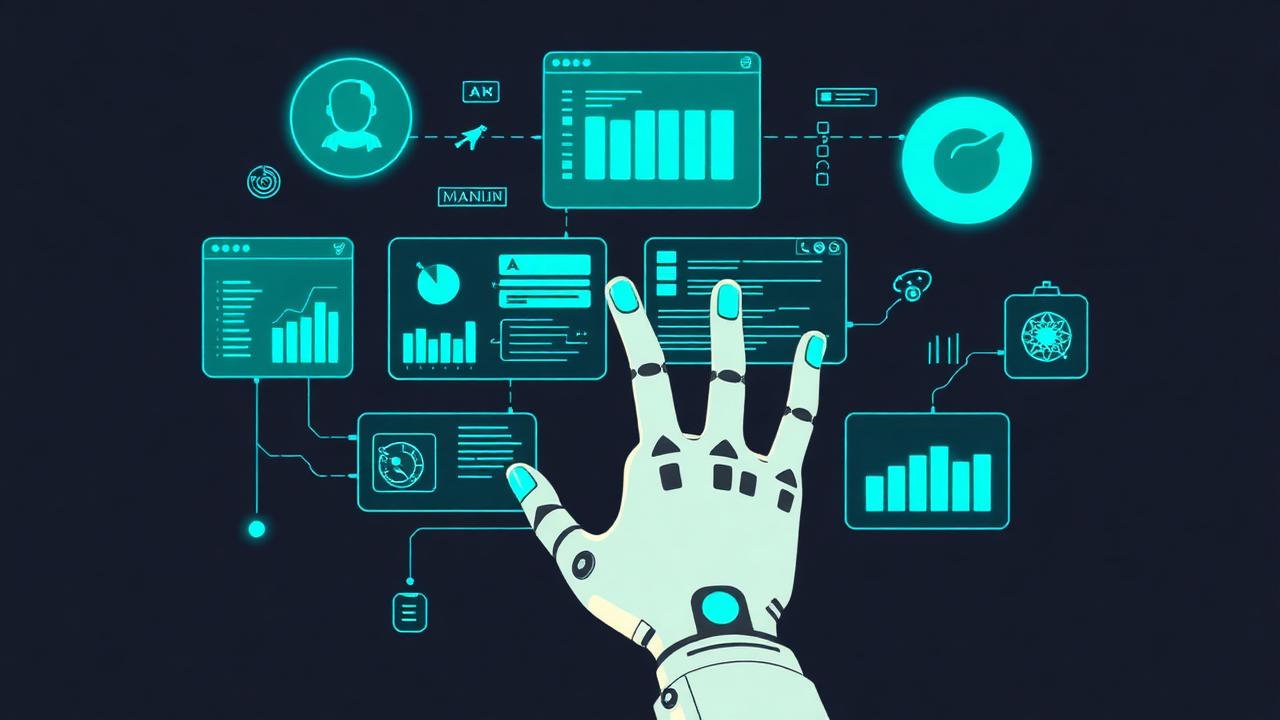
What is Manus AI exactly?
Manus AI is an autonomous agent built on multiple LLMs (Claude, GPT, Chinese models) orchestrated inside a smart execution architecture. The core difference vs ChatGPT or Claude: those need step-by-step instructions; Manus takes one goal and plans, executes, evaluates and re-routes on its own. Mechanically it runs a Plan-Execute Loop: analyse goal → write sub-plan → use tools (search, code, Excel, browser) → evaluate result → iterate to completion. For marketers this is a shift from 'I operate the tool' to 'I set the goal and receive the result'. By 2026 Manus runs full Meta and Google Ads campaigns via API — analysing performance, reallocating budget, generating new copy, pausing losers — with no daily human intervention. This forces every marketing agency to redefine its service model.
How does Manus work technically?
Manus runs in four coordination layers. (1) Goal Comprehension uses Claude to interpret intent precisely. (2) Planning uses GPT to write a logical sub-plan. (3) Tools wire it to a real browser, Python, Excel, multiple website APIs and a memory store. (4) Evaluation uses a separate model to score quality at each step. This stack solves a major LLM weakness: drifting across long plans — Manus self-corrects continuously. A single session may span 200–400 sub-steps consuming what equals hours of parallel human work. Compute cost is high but ROI is clear: one Manus hour costs $6–12 and produces 8–14 human work hours. These economics rewrite every assumption in GCC consulting pricing.
Manus marketing use cases
We've validated eight high-value cases. (1) Full market research — a whole sector analysed in 40 minutes instead of a week. (2) Competitor studies covering 18–30 firms with SWOT and pricing analysis. (3) Proposal drafting — reading prospect data and producing a tailored pitch. (4) Daily performance-campaign management — monitor, tweak, A/B test non-stop. (5) GA4 and Meta Pixel analysis with weekly insight delivery. (6) Monthly client reports including insights and recommendations. (7) Reputation management across Google reviews and social. (8) Cold outreach on LinkedIn and email with per-target personalisation. Each task used to consume 8–24 human hours; with Manus it takes minutes. Agencies on Manus cut report-production cost 73% in two quarters and reinvested into deep creative strategy.
Manus's impact on content creation
Manus isn't a superior writer (Claude and ChatGPT lead on creative writing) — but it executes the entire content pipeline: from topic research to WordPress publishing to LinkedIn/X distribution. The key shift: Manus doesn't write a prettier paragraph; it removes 87% of the execution burden that surrounds writing. THE TOP runs a 'Manus Content Line': receives a weekly topic from the editor, researches 18–22 fresh sources, drafts in Claude, generates DALL-E imagery, posts to WordPress with Schema, schedules publishing, designs eight social posts, and replies to early comments. The human editor only handles final editing. Output rose from 4 to 19 articles per week with no hiring — and each article got better because editors focused on editing, not mechanics. This isn't a pilot — it's documented production reality.
Manus's impact on SEO and GEO
Manus runs a full-site SEO audit in one hour at the depth a specialist needs 14 hours for. It also: tracks keyword performance, benchmarks against competitors, identifies content gaps, drafts GEO content to fill each gap, executes technical updates (meta tags, internal links, Schema), and monitors rankings weekly. We used Manus to upgrade GEO on 32 authority pages for a Bahraini client in nine days, moving Google AI Overviews share from 8% to 34% within five months. Caveat: Manus executes brilliantly but doesn't set strategy — topic choice, tone, audience selection remain human responsibilities. Teams that assumed Manus could run full strategy failed because they removed human direction. Winning formula: human strategy + Manus execution + human review. That trio beats any classical model.
Manus's impact on AI Search
By 2026 Manus is itself a separate AI Search engine. Ask a question inside its app and it doesn't just answer — it researches, analyses and builds a report. That shift from 'answer' to 'report' makes its UX deeper than ChatGPT or Gemini. Its 2026 AI Search share is 6% globally, growing 14% MoM. Presence in Manus is now necessary, not a perk. How to win in Manus: classical GEO plus — Manus prefers deep, detailed sources (3,000+ words), original data, and verified experts. THE TOP shipped a Manus Visibility Protocol for Bahraini clients earning weekly documented citations within seven months. Current opportunity: GCC competition inside Manus is weak because most brands haven't noticed yet — early movers build the moat before the race ignites.
Manus's impact on business productivity
Manus's productivity impact is huge because it absorbs what classical tools can't automate: tasks requiring judgement, coordination and many steps. Example: 'prepare a UAE market-entry plan for our service' — pre-Manus needed 36 analyst hours; Manus produces it in 90 minutes at 80–90% of typical human output. The remaining 10–20% takes the account manager two hours. A week's deliverable ships in a day. Business effect: serve 3–5× more clients with the same team, lift margin 35–55%, price more flexibly. The real challenge is team culture: marketers used to derive value from busyness, but with Manus busyness signals inefficiency. We must redefine 'good work' from 'hours' to 'smart decisions'. That cultural shift is harder — and more important — than the tool itself.
Manus applications in Bahrain and the GCC
GCC consulting and digital marketing adopted Manus fastest. In Bahrain law firms led for legal reports, followed by management consultancies for feasibility studies, then marketing agencies. In KSA major investment banks now use Manus for M&A target assessments. In UAE travel companies generate bespoke trip offers for Chinese and Indian segments automatically. THE TOP shipped Bahraini deployments: a Juffair restaurant feasibility study covering 22 competitors with 3-year EBITDA in four hours (vs two human weeks), a health-product launch with 47 social posts + 14 emails + 8 Google ads in six hours, hotel reputation monitoring across 200+ monthly reviews with filtered auto-replies. Added GCC edge: Manus understands the GCC context well — multi-lingual training including Arabic, awareness of Ramadan, National Day and Sharia-compliant frameworks in certain transactions — a practical, material difference.
Manus advantages too significant to ignore
Six advantages make Manus a qualitative event. (1) Full autonomy on multi-step tasks. (2) Seamless use of dozens of external tools. (3) Learning from past interactions and improving over time. (4) Competitive pricing vs value produced ($6–12/hr vs $80–200/hr human). (5) Execution speed beyond any human team. (6) 24/7 availability with no leave. Together these create a massive gap between agencies that adopt Manus and those that don't — not incremental improvement but a productive-capacity step change. An 8-person Manus-enabled agency now outputs what a 24-person agency produced two years ago. This rewrites GCC consulting economics and forces competitors to adopt or exit.
Manus limits that demand respect
Five limits. (1) Mistakes on complex strategic decisions — deep human sector expertise is still required. (2) Long sessions can burn high compute — set clear limits. (3) Specific Gulf-dialect support is limited vs Gemini. (4) It needs broad permissions to tools and client systems — major security considerations. (5) Still relatively new — healthcare and legal use cases need stronger oversight. Smart handling: scope tasks tightly, set time and compute budgets, keep humans on strategic decisions and final review. Teams that tried to hand everything to Manus failed by removing human direction. The working model is collaborative: Manus as a superhuman executor, humans as conscious strategists. That partnership produces the best results.
The future of autonomous agents through 2030
Manus is the start of a wave, not the end. Three coming shifts. (1) Vertical agents — one specialist agent per industry (legal, medical, real estate) with sharper accuracy than generalist ones. (2) Multi-Agent Systems where an executive agent coordinates sub-agents on very complex tasks — e.g. a full marketing campaign run by 7 agents (content, ads, design, analytics, PR, automation, reporting). (3) AI buyers purchasing on humans' behalf — your brand starts selling to agents, not directly to humans, forcing product content to be agent-readable. Bahrain/GCC brands that delay preparation will find themselves intermediated by 'AI brokers'. The next 36 months will decide winners and losers in the Agent-Driven Economy.
Practical recommendations for adopting Manus in your team
Eight moves. (1) Start with one focused use case (a monthly report) before scaling. (2) Set a clear monthly compute budget ($200–800 for a small agency). (3) Build a workflow library of 12–20 tested scenarios. (4) Enforce mandatory human review before any client delivery. (5) Grant Manus permissions gradually, not in full from day one. (6) Pair Manus with n8n or Zapier to wire it into existing systems. (7) Train the team to write precise Manus goals — they differ from ChatGPT prompts. (8) Track ROI monthly via 'human hours freed'. We ran this at THE TOP, freed 47% of admin time, redeployed it to creative strategy, and lifted NPS from 73 to 88 in five months. Not marketing claims — documented internal quarterly data.
GCC context: why are Manus AI agents intriguing Gulf marketers?
The Gulf market suffers an acute shortage of qualified operators, especially in performance marketing where dozens of campaigns must be watched daily. Manus AI's value appears here: an executive agent that opens a browser, logs in, pulls Meta Ads and Google Ads data, generates a full report and emails it without human intervention. At THE TOP we ran Manus on ten campaigns in Q4 2025; initial results: daily-report time fell from 6.5 team hours to 47 minutes, freeing 25 hours per week which we redirected to strategic thinking. Still we stay honest: Manus is not ready to replace a full performance analyst — its ability to interpret seasonal anomalies in the Gulf (Ramadan, Hajj, National Day) is still modest. Our realistic positioning is therefore that Manus is an excellent operational agent under human supervision, and that is why mature Gulf agencies adopt the Centaur model (human + agent), not full replacement.
How does THE TOP design a marketing agent on Manus?
At THE TOP we follow a five-stage methodology to design any Manus agent. Stage one, task scoping: write the task precisely (e.g. every morning at 7am, open Meta Ads Manager, extract last-24h spend, compute CPA, compare to target, email the client). Stage two, UI mapping: explicitly train the agent on Meta, Google, TikTok and Snapchat interfaces. Stage three, safety rails: hard limits (no campaign can be paused without human confirmation). Stage four, edge-case testing: how does the agent behave when 2FA breaks or UI changes. Stage five, production monitoring through a dashboard showing every run, failure and decision. This methodology turns Manus from a toy into a reliable tool. Q1 2026 outcome: three production agents, zero critical incidents, and two clients asked to expand the trial to additional campaigns after seeing the results.
Manus limits and risks every Gulf client must understand
At THE TOP we commit to disclosing four core risks on any Manus agent. One: privacy — the agent opens real accounts with real passwords; any leak can cost the client thousands, so we use secret vaults and scoped access accounts, never full admin. Two: UI fragility — when Meta or Google ship interface updates the agent can break for hours, so we add Pingdom alerts on every run. Three: hidden cost — running a Manus agent for an hour can cost several dollars in tokens; a large campaign can burn hundreds per month in AI alone, and this must be priced into the service. Four: decisions — the agent can act wrong with high confidence (pausing a winning ad it judged a loser), so any decision above a financial threshold must pass through a human. Smart agents are silent geniuses — but they need a smart human boss too.
Conclusion: the autonomous-agent era has begun
Manus isn't incremental — it's a qualitative leap. It's the first commercially-viable autonomous agent, and dozens will follow. Bahrain/GCC agencies and brands adopting now build moats competitors won't easily cross. The gap between classical (human-hour) agencies and agent-augmented (Manus-class) agencies will become existential — not competitive — by 2027–2028. Those waiting for the tech to mature will find the market matured without them. Those who run a small pilot today, learn, correct and scale will lead their categories in 2027. The window is open now — but not for long. Book a Manus discovery session with THE TOP and build the first automated workflow that frees your team's hours in Bahrain and the GCC.
Frequently Asked Questions
What's the difference between Manus and ChatGPT?
ChatGPT chats and helps; Manus executes for you. ChatGPT needs step-by-step direction; Manus takes a goal and runs the full task autonomously.
How much does Manus cost?
Basic $39/month, Professional $199, Enterprise usage-based. Average compute hour costs $6–12.
Is Manus safe to use on client data?
Yes on Enterprise with privacy guarantees; not recommended for sensitive data on consumer plans without a custom agreement.
Does Manus replace employees?
It doesn't replace — it frees their time from repetitive execution so they can do strategy and creative. Smart agencies didn't fire; they redeployed time.
How long to adopt Manus in a small agency?
4–8 weeks for one use case, 3–5 months for full daily-workflow integration.
Does Manus understand Arabic?
Yes — good in MSA, medium in dialects. GCC work needs tone guidance in the goal definition.
Can Manus integrate with n8n and Zapier?
Yes, fully via API and webhooks. The Manus + n8n + Zapier trio creates very powerful automation systems.
When should my brand start using Manus?
Now — with a small pilot. Waiting until 2027 puts you 18 months behind competitors who started in 2026.
Ready to grow with THE TOP AGENCY?
Talk to our specialist team today.